


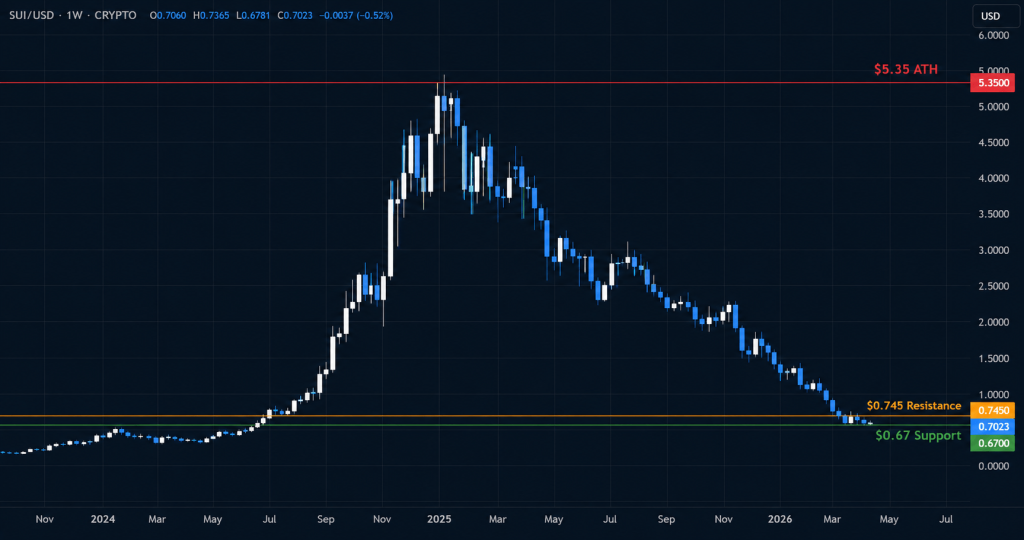
The Best Forex Brokers and crypto trading platforms that handled the most volume in 2025 had one thing in common: they all listed SUI within weeks of each other, and the retail crowd largely ignored it. That was a mistake worth examining in 2026, when SUI sits at $0.72 having once touched $5.35, trades half a billion dollars per day in volume, and runs a network processing nearly 4.4 million transactions every 24 hours.
This isn’t a price prediction. It’s a trading analysis of why SUI’s current setup is more interesting than its price chart suggests, what the real risks are, and how active traders can think about positioning in an asset that most of the market has written off as another failed altcoin.
What SUI Actually Is and Why It Matters for Traders
Sui is a Layer-1 blockchain built by former Meta engineers who worked on the Diem (Libra) project. The core engineering decision that separates it from Ethereum, Solana, and most other L1s is an object-centric data model combined with parallel transaction execution. In plain terms: independent transactions don’t wait in line. They run simultaneously. The result is transaction finality measured in seconds, not minutes, and a network that has processed tens of billions of lifetime transactions without the congestion events that periodically cripple Ethereum and, occasionally, Solana.
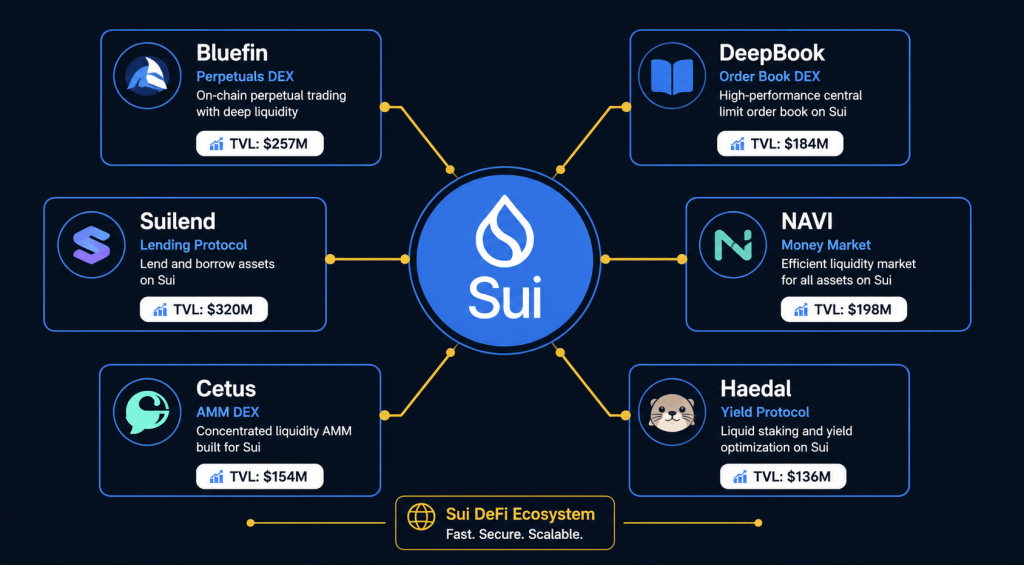
For traders specifically, these technical characteristics translate into something concrete. Bluefin, the largest perpetuals DEX on Sui, processed $257 million in derivatives volume on a single day in August 2026. DeepBook, a central limit order book DEX native to Sui, is attracting institutional-grade liquidity. Suilend and NAVI handle lending and borrowing. The on-chain infrastructure that supports serious trading activity is present and operational, not theoretical.
SUI’s developer base grew 159% year-over-year in 2026 according to CoinStats AI data. Developer growth at this pace in a bear market for the token price is one of the clearest signals of genuine long-term commitment to a network.
The Price vs. Fundamentals Disconnect
Here is the core trading thesis in one paragraph: SUI’s token price is down 85% from its all-time high. Its network, by most on-chain metrics, is not down 85% from its peak. Transaction volumes remain in the billions per month. Monthly active users grew from 10 million to 40 million over the past year. The network ran 4.38 million transactions in a single 24-hour period as of mid-2026. That kind of on-chain activity does not coexist with a dead project. It coexists with a project whose token has been repriced by macro conditions, token unlock pressure, and rotation into Bitcoin, not by any collapse in actual utility.
“TVL can lie. Transaction count can lie. But 40 million monthly active users generating billions in cumulative volume is harder to fake than a DeFi incentive program.”
The TVL story is worth examining closely because it’s where the bear case for SUI gets its strongest material. Total DeFi TVL on Sui peaked above $1 billion in July 2026, and sits around $455 million currently, down from the $2.6 billion peak reached in October 2025. That’s a real decline and deserves honest treatment. A large portion of the peak TVL was incentive-driven capital that moved out when emissions slowed. What’s left is stickier: yield opportunities above 50% APY on some Sui DeFi protocols are still attracting capital even during the price slump.
SUI vs. Competing Layer-1s: Where It Stands
| Metric | SUI | Solana (SOL) | Aptos (APT) | Avalanche (AVAX) |
|---|---|---|---|---|
| Price vs ATH | -85% | -55% | -78% | -72% |
| Market Cap (approx.) | $2.96B | $58B+ | $2.1B | $7.8B |
| 24h Trading Volume | $387–540M | $1.2B+ | $120M | $180M |
| DeFi TVL (current) | ~$455M | ~$4.2B | ~$280M | ~$650M |
| Daily Transactions | 4.38M+ | 60M+ | ~800K | ~700K |
| Developer Growth YoY | +159% | +18% | +90% | +12% |
| CMC Rank | #29-32 | #5 | #35 | #12 |
The comparison that matters most is SUI vs. Aptos. Both use the Move language, both were founded by ex-Meta engineers, both launched their mainnets in 2023. Against Aptos, the comparison is tight, but SUI is running five times the daily transaction volume at a similar market cap. If Aptos trades at $2.1 billion with 800K daily transactions, the question worth asking is why SUI trades at $2.96 billion with 4.38 million daily transactions. That gap looks like an inefficiency, not a rational pricing difference.
The Real Risks: What the Bull Case Gets Wrong
Any honest analysis of SUI has to confront three structural problems that aren’t going away in the short term.
Token Unlock Pressure
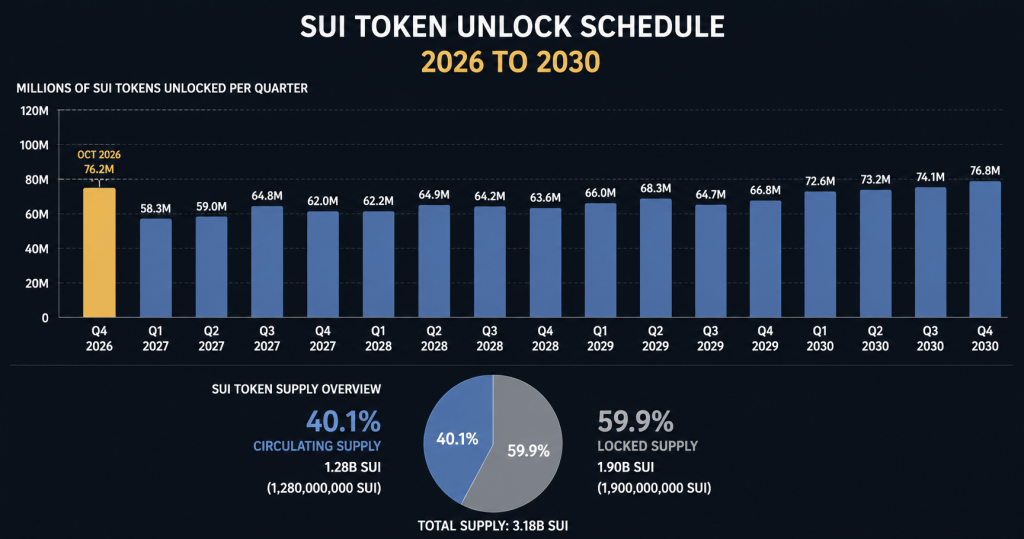
Only 40.1% of total SUI supply is currently circulating, creating a multi-year dilution overhang until 2030. The next token unlock is scheduled for October 1, 2026, which will release 13.26 million SUI tokens representing 0.13% of total supply. Individual unlocks of this size aren’t catastrophic, but the cumulative schedule means consistent selling pressure from early investors and team allocations through the end of the decade. Every rally faces a structural headwind. Traders need to track the unlock calendar the way equity traders track earnings dates.
Competition from Solana
Solana is the dominant high-performance L1 and has established network effects that Sui doesn’t yet have. DeFi liquidity, NFT ecosystems, institutional familiarity, and developer tooling are all deeper on Solana by a significant margin. For Sui to re-rate meaningfully, it either needs to capture use cases Solana isn’t serving well, or it needs Solana to stumble. The former is more realistic than the latter.
Fee Revenue Gap
Network fee revenue on Sui runs at approximately $15 million annualized, compared to $500 million or more for Ethereum and Solana. This matters for long-term token value because fee revenue is the clearest signal of genuine economic activity paying to use the network. SUI’s fee revenue needs to grow by at least an order of magnitude before the network can be considered economically self-sustaining rather than incentive-dependent.
SUI Key Price Levels for Traders
| Level | Price (USD) | Significance | Relevance |
|---|---|---|---|
| Critical Support | $0.64–0.67 | Multi-week demand zone, high volume cluster | Break below opens $0.55 test |
| Current Range | $0.70–0.78 | 24h price action range, seller/buyer equilibrium | Active trading zone Q3 2026 |
| Short-term Resistance | $0.745 | Reclaim needed to invalidate bearish bias | Key level per CoinMarketCap analysis |
| Medium Resistance | $1.10 | Psychological level, breakout confirmation zone | Trend reversal signal if reclaimed |
| Bull Target 2026 | $3.50 | Analyst consensus bull case, requires macro tailwind | Coinpedia bull scenario |
| All-Time High | $5.35 | Set January 6, 2025 | -85% from current levels |
The $0.745 level is the key short-term line. Below it, the structure is bearish and swing traders should wait for confirmation rather than buying into weakness. A weekly close above $0.745 with expanding volume changes the picture materially.
How Active Traders Are Positioning
The two approaches most active traders are using on SUI right now reflect the uncertainty in the asset.
Range Trading the $0.67–$0.78 Band
With clear support at $0.64–0.67 and resistance at $0.745–0.78, SUI has been printing a tradeable range for several weeks. Traders buying support with tight stops below $0.63 and selling into resistance have been extracting value from the chop without taking directional risk on the macro situation. This works until it doesn’t, and the unlock calendar on October 1 is a known catalyst that could break the range downward.
Accumulation with a Long Time Horizon
The second approach treats current levels as a potential accumulation zone for a 12–24 month hold. Coinpedia’s bull scenario for SUI targets $3.50 in 2026 if bullish momentum returns across the broader crypto market, with an average price target around $2.20. Dollar-cost averaging into a position at current levels and holding through the unlock overhang is the strategy institutional-minded traders are reportedly running, per KuCoin research. This requires conviction that the network’s fundamentals justify a much higher valuation than the market is currently pricing, and tolerance for further downside if macro conditions deteriorate.
SUI Risk/Reward Scenarios for Traders
| Scenario | Trigger | SUI Price Target | Probability Assessment | Key Risk |
|---|---|---|---|---|
| Bear case | Break below $0.64, macro risk-off, unlock selling | $0.50–0.55 | Elevated near-term | Cascading stop-loss triggers |
| Base case | Range holds, slow ecosystem growth, sideways BTC | $0.70–1.10 | Most likely Q4 2026 | Time decay on range positions |
| Bull case (moderate) | BTC break above $100K, altcoin rotation begins | $2.00–3.50 | Possible H1 2027 | Unlock pressure caps rallies |
| Bull case (full) | Gaming/AI narrative + DeFi TVL recovery above $2B | $3.50–5.00 | Low, but asymmetric | Requires multiple macro tailwinds |
The Institutional Signal Worth Watching
In August 2026, Neuberger Berman partnered with Securitize to launch a tokenized fixed-income fund on Sui and other blockchains. Neuberger Berman manages over $400 billion in assets. That a firm of this size chose Sui as an infrastructure layer for a real financial product is a qualitatively different signal than a venture fund taking a token position. It means Sui’s technical infrastructure was evaluated by people whose job is institutional due diligence, not crypto speculation, and passed.
This doesn’t guarantee price appreciation. Plenty of technically sound networks have traded sideways or lower for years. But it removes one of the core bear arguments: that Sui is purely a retail speculation vehicle with no serious institutional engagement.
The Bottom Line for Traders
SUI is not a simple trade. 2026 is where the market either accepts Sui as a serious L1 alongside Solana and the larger Ethereum L2s, or keeps it in the “narrative alt” bucket. The data argues for the former. The price argues the market hasn’t decided yet.
For range traders: the $0.67–0.78 band is active and has clear levels. Watch October 1 unlock as a potential range-break catalyst.
For longer-term traders: SUI at $0.72 with 40 million monthly active users, 159% developer growth, and Neuberger Berman building on the network is a setup that’s hard to find at this market cap. The unlock overhang is real and the macro environment is uncertain. Size accordingly.
What SUI is not, in 2026, is the finished story the price action implies. A network processing 4.38 million daily transactions doesn’t belong in the “dead project” category. Whether the token price eventually reflects that is a different question, one only the market can answer.
This article is for informational and educational purposes only. Nothing in this article constitutes financial or investment advice. Cryptocurrency trading involves significant risk of loss. Price data referenced reflects conditions as of Q3 2026 and may have changed. Always conduct your own research before making any trading or investment decision.



$15 million fee revenue compared to over $500 million for Ethereum and Solana really shows where SUI stands right now! For someone who just started DCAing around $0.70, is that something to worry about?
@TradingTina Right? Plus, did you see that TVL dropped from $2.6B to $455M? That’s not just a dip; that’s an iceberg hitting the Titanic!
@LinaTheExplorer Great question! Those transactions show SUI is actively being used, which is a good sign of interest in the network. More transactions usually mean more people are engaging with it, which can be positive for its future.
@SkepticalSam Honestly, if you’re in for the long haul, dollar-cost averaging might be better than trying to time those unlocks. Just don’t expect quick returns.
So, SUI dropped from like 5 bucks to 70 cents? I must’ve missed the memo on that one! Is it really worth looking into?
“40 million monthly users generating billions in volume” sounds impressive, but isn’t the falling TVL from $2.6B to $455M concerning? That seems like a bad sign.
$0.70–$0.78 seems like a good trading range now according to the article! I’m considering range trading instead of DCA with my small deposit; is that advisable?
Wow, I didn’t realize SUI’s price dropped so much from its ATH! From $5.35 to around $0.72 is a huge fall. How do I know if it’s a good time to buy in?
@SkepticalSam It does seem like a drop, but keep in mind that some of that was incentive-driven capital which might not stick around anyway. What’s left could be more reliable investments that see consistent use.
I just started learning about crypto, and I heard about SUI having 4.38 million daily transactions! What does that really mean for us regular folks?
@AnnoyedAlex What does TVL even mean? I’m still trying to wrap my head around all this crypto lingo!
@CryptoNewbie22 It’s definitely an eye-opener! A lot of traders are looking at the $0.67–0.78 range for buying. Just remember to watch for support at $0.64, and maybe set a stop-loss there if you decide to trade.
@DCA_Dude Not necessarily! The fee revenue gap shows room for growth as SUI develops further. If they can improve their DeFi offerings, those numbers might change over time!
What does TVL even mean? I see it mentioned a lot in these articles, but I’m not sure how it affects my investments.
@BeginnerBob TVL stands for Total Value Locked. It’s basically how much money is being used in a DeFi platform. A high TVL usually means that people trust and are actively using the platform.
$0.64 seems like an important support level according to the article. If it breaks below that, what do you think will happen?
@SkepticalSam Yeah, that drop is concerning, but the remaining capital is considered stickier and more reliable. Plus, some protocols still offer high yields above 50% APY, which can attract users.
Wow, I didn’t realize SUI fell so much! From over $5 to just $0.72 is a huge drop. Is it really worth looking into at this price?
@NewbieNina Total Value Locked; it’s basically how much money is in DeFi protocols on SUI. But honestly, with that drop in value and Solana outperforming it by miles, it feels like a lost cause.
@#CryptoFanatic If it drops below $0.64, we could see it testing $0.55 next! I’ve seen that kind of reaction before with other coins during critical levels.
@CuriousCathy It might be! The article mentions that SUI has about 4.38 million transactions daily. That level of activity usually means there’s something valuable happening. Just keep an eye on the upcoming unlock on October 1.
@DCA_Dude Not necessarily! Just because TVL fell doesn’t mean it’s untrustworthy; you have to look at other factors too, like user growth and developer activity — which are strong for SUI right now.
@HelpfulHank So if SUI’s TVL has dropped significantly, does that mean it’s less trustworthy? I’m trying to decide if I should DCA or trade the range.
@CryptoCurious Yeah, and with only 40.1% of the supply out, it’s like waiting for a slow-motion train wreck till 2030. What’s the point of buying now?
4.38 million daily transactions sound impressive, but if they’re barely making $15M a year in fees, what’s the actual point? Seems like a lot of hype.
@TradingTim But isn’t the TVL down from $2.6 billion to around $455 million? That feels like a big red flag to me.